
Truck Dispatch Service Cost in Texas
Truck dispatch service pricing in Texas varies by provider, service scope, equipment, truck count, load volume, and contract structure. Current 2026 industry pricing guides commonly describe percentage-based, flat-fee, per-load, and hybrid arrangements, but there is no official Texas dispatch-fee schedule that establishes one "correct" price.
For a carrier, the useful question is not simply "What percentage does a dispatcher charge?" It is "What will this service actually cost me, what does that fee cover, and how does it compare with the alternatives?" For transparent, zero-hidden-fee rates, you can explore Bonafide's best dispatch service in Texas.

Request Quote Info
Calculate dispatch costs based on your fleet structure.
How Much Does Truck Dispatch Cost in Texas?
Current 2026 industry sources commonly publish percentage-based dispatch fees around 5% to 10% of gross revenue, while other providers advertise flat weekly, per-load, or hybrid arrangements. O Trucking's June 2026 update, for example, reports 5%–10% as its stated range and identifies flat per-load and monthly models as alternatives. Atom Dispatch's May 2026 guide similarly describes 5%–10% percentage pricing and $250–$650 weekly flat-fee examples.
These are industry-published market examples, not a Texas regulatory standard.
The actual cost of a dispatch service can depend on:
- • How the fee is calculated
- • What services are included
- • How many trucks are dispatched
- • Equipment type
- • Load volume
- • Whether the service charges additional fees
- • Contract and cancellation terms
That is why comparing two dispatch companies requires more than comparing their advertised percentages.
The Main Truck Dispatch Pricing Models
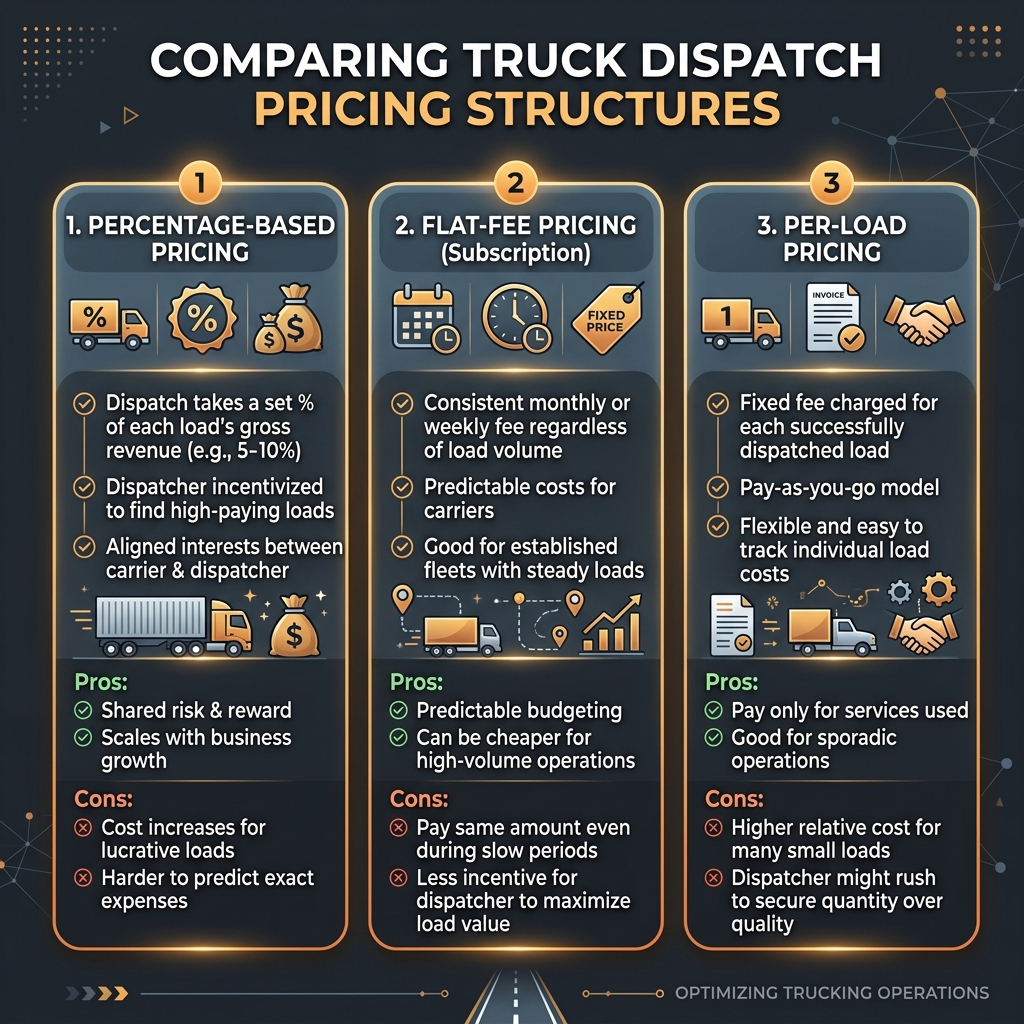
Dispatch providers generally operate under one of four core fee structures. Let's compare their mechanics.
Percentage of gross
Under a percentage model, the dispatch company receives an agreed percentage based on the revenue definition in the contract.
Example: If a hypothetical load pays $5,000 and the agreed fee is 6%:
$5,000 × 0.06 = $300 dispatch fee
That calculation is only valid if the agreement defines the entire $5,000 as the fee base.
Before accepting a percentage quote, ask:
- • Is the percentage based on gross revenue?
- • Does it apply to linehaul only?
- • Is fuel surcharge included?
- • Are detention or accessorials included?
- • Is there a minimum fee?
- • Are there additional charges?
Flat weekly or monthly fee
A flat-fee arrangement charges a predetermined amount rather than changing directly with the truck's gross revenue.
Example: A hypothetical $350 weekly fee remains $350 whether the truck grosses $4,000 or $7,000 that week, assuming the agreement contains no other variable charges.
Atom Dispatch currently publishes a $250–$650 weekly example range, which is one provider's published market example rather than a required price.
Per-load fee
Some dispatch arrangements charge a fixed amount for every load dispatched.
Example: If a dispatcher charges $100 per load:
- • 5 loads = $500
- • 10 loads = $1,000
- • 15 loads = $1,500
The effective percentage changes: a $100 fee on a $2,000 load represents 5%, while on a $1,000 load it represents 10%. Evaluate a per-load quote against typical load value and volume.
Hybrid pricing
A hybrid arrangement combines fixed and variable charges.
Example: Combining a weekly base fee plus a percentage, or a minimum charge plus a percentage. Calculate the total expected cost, not just the percentage component.
What Does the Dispatch Fee Actually Cover?
Two services can advertise similar prices while providing very different levels of support. Before comparing prices, determine what the dispatcher actually does.
Depending on the agreement, dispatch work can include activities such as finding potential loads, communicating with brokers, negotiating load terms, coordinating load information, handling carrier packets, assisting with rate confirmations, managing paperwork, following up on accessorials, and other administrative support.
"Full-service dispatch" is not a standardized package. Ask: "What exactly is included in the fee, and what costs extra?" A higher fee can be reasonable if the contracted scope is substantially broader. A lower fee may not be a better deal if important responsibilities remain with the carrier.
What Can Make Dispatch Cost More or Less?
Several operational details affect the price a provider offers:
• Number of trucks: Fleet size can change the amount of dispatch work involved and how the provider organizes the account.
• Equipment: Dry van, reefer, flatbed, hotshot, step deck, lowboy, or car hauler can involve different freight requirements. Ask specifically how the pricing applies to your equipment.
• Load volume: A percentage fee rises as gross revenue rises. A flat weekly fee generally does not. A per-load fee rises as the number of loads increases.
• Service scope & Contract structure: Load-matching only vs full communication, and cancellation or onboarding commitments can change the effective cost.
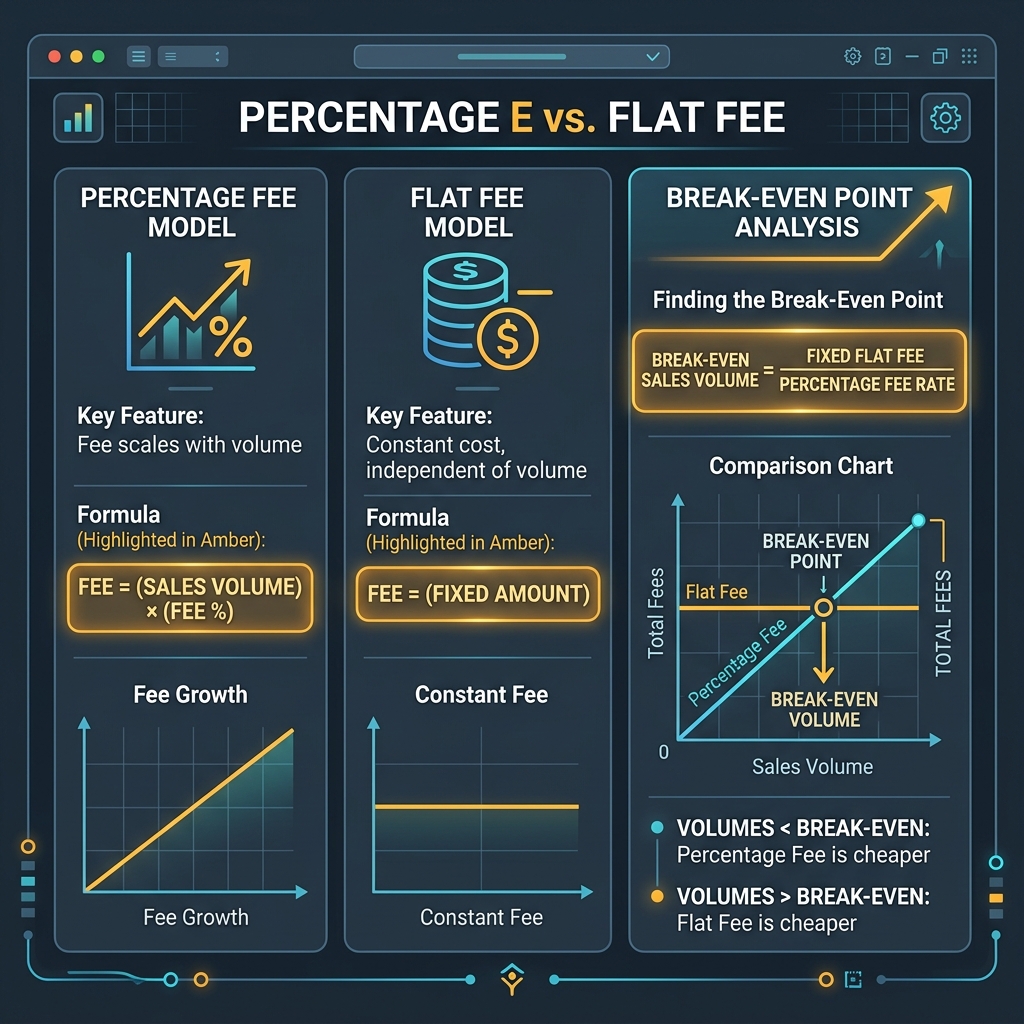
How to Compare a Percentage Fee With a Flat Fee
The easiest way to compare dispatch pricing is to convert everything into dollars.
| Pricing model | Calculation | Weekly dispatch cost |
|---|---|---|
| 5% (on $6,000 gross) | $6,000 × 5% | $300 |
| 6% (on $6,000 gross) | $6,000 × 6% | $360 |
| 8% (on $6,000 gross) | $6,000 × 8% | $480 |
| $300 Flat | Fixed | $300 |
| $400 Flat | Fixed | $400 |
| $100 per load (5 loads) | 5 × $100 | $500 |
These are illustrative calculations only. They are not Bonafide pricing or a recommendation that any particular fee is appropriate.
You can calculate where a percentage fee equals a flat fee:
Suppose: percentage fee = 6%; flat fee = $360 per week. Then: $360 ÷ 0.06 = $6,000. At $6,000 of weekly gross revenue, both models cost $360. If the truck grosses more, the flat fee is cheaper. If less, the percentage is cheaper.
Watch for Additional Fees
The advertised dispatch percentage or flat fee may not be the entire cost. Check for:
- • Setup or onboarding fee
- • Technology or software platform fee
- • Administrative or document retrieval fee
- • Cancellation/early-termination fee
- • Paperwork charges for manual filing
- • Extra per-load or minimum-week charges
Ask: "If I use this dispatcher for one month, what charges could appear on my bill or settlement?" Request the complete pricing details in writing.
Contract Terms Can Change the Real Cost
Review details like the fee base (linehaul vs total gross including fuel), contract duration (month-to-month vs term), cancellation notice requirements, exclusivity rules (restricting self-dispatching or booking own loads), and payment method. The contract—not a salesperson's verbal explanation—should be the basis for your understanding.
Compare the Service, Not Just the Price
A dispatch fee is only one side of the calculation. Suppose one service charges 5% and another charges 8%. It would be tempting to conclude that the 5% service is automatically cheaper. But if they have different load-finding, negotiation, paperwork, and broker communication capabilities, then they are not equivalent.
Texas Does Not Have One Standard Dispatch Price
Texas has a large freight transportation network. TxDOT's Texas Connected Freight Corridors project covers an 865-mile network involving I-35, I-45, and I-10, including an I-35 extension to Laredo and connections between Austin, Dallas-Fort Worth, Houston, and San Antonio.

TxDOT's 2024 International Trade Corridors Plan also identifies I-10, I-35, I-45, I-20, I-69, I-37 and other routes as international or regional trade corridors. That geographic scale means Texas carriers can have very different operating patterns.
One carrier may operate mainly within Texas, another may regularly cross state lines, and a third may operate through border markets like Laredo. Ask: "How does your pricing match my Texas operating pattern?"
How to Compare Two Dispatch Quotes Fairly
| Question | Dispatcher A | Dispatcher B |
|---|---|---|
| Pricing model & fee | ... | ... |
| Fee base definition | ... | ... |
| Setup & tech fees | ... | ... |
| Contract length & cancellation | ... | ... |
| Services included | ... | ... |
| Equipment supported | ... | ... |
Is a Truck Dispatch Service Worth the Cost?
Evaluate the cost by looking at: time spent searching for freight, time communicating with brokers, negotiation efforts, paperwork, selection assistance, and your own ability to perform these tasks.
For a broader process of evaluating a dispatcher, see How to Choose a Truck Dispatch Service in Texas.
Evaluate Bonafide's Dispatch Services for Texas
Bonafide Trucking Solutions' locked business information does not include a dispatch percentage, flat fee, setup fee, contract term, or guarantee, so no Bonafide price is stated here.
If you have compared the pricing structure and service scope and want to evaluate Bonafide specifically, you can review Bonafide's truck dispatch service in Texas.
Frequently Asked Questions
How much does a truck dispatch service cost in Texas?
There is no official Texas dispatch-fee schedule. Current 2026 industry sources commonly publish percentage-based examples around 5%–10%, while flat weekly, per-load, and hybrid arrangements are also advertised. The exact cost depends on the provider, service scope, equipment, volume, and contract.
What percentage do truck dispatchers usually charge?
Current industry pricing guides commonly cite 5%–10% of gross revenue, but published ranges vary. These are industry sources, not an FMCSA-mandated rate or Texas pricing standard.
Is it better to pay a dispatcher a percentage or flat fee?
Neither is automatically better. A percentage changes with gross revenue, while a flat fee is generally fixed for the agreed period. Calculate both models using your expected revenue and load volume.
Do truck dispatch services charge setup fees?
Some current providers advertise setup or onboarding fees, while others advertise no setup fee. There is no universal rule. Ask for every initial and recurring charge in writing before agreeing to service.
What is included in a truck dispatch fee?
It depends on the agreement. Possible services include load searching, broker communication, negotiation, paperwork, and other dispatch-related support. Never assume that a task is included simply because a provider calls its service 'full service.'
How can I compare two dispatch quotes fairly?
Convert both offers into expected dollar costs using the same revenue and load assumptions. Then compare the fee base, included services, additional charges, contract terms, cancellation provisions, and payment structure.