
Best Truck Dispatch Companies in Texas
There is no single truck dispatch company that is automatically the best choice for every Texas carrier. The better choice depends on what you haul, how many trucks you operate, where you run, how much dispatch work you want to delegate, how the company charges, and how much control you want to retain.
Texas carriers can encounter national dispatch companies, regional providers, owner-operator-focused services, fleet-oriented operations, equipment specialists, and providers offering different pricing and service models. Understanding those categories makes it easier to distinguish a dispatch company that fits your operation from one that simply makes attractive marketing claims. If you want to see how a professional provider organizes its service model, check out Bonafide's best dispatch service in Texas.
Compare Service Options
Request assistance from our trucking coordinators.
What Makes a Truck Dispatch Company "Best" in Texas?
The word "best" is difficult to apply objectively to dispatch services because carriers have different requirements. An owner-operator running one dry van may need a different type of service from a small fleet operating several reefers. A flatbed carrier may prioritize equipment knowledge, while a carrier operating throughout the country may value broad geographic coverage.
| Factor | Why it matters |
|---|---|
| Service model | Determines how much dispatch work the company handles. |
| Equipment knowledge | Different equipment requires different freight considerations. |
| Fleet focus | A single-truck carrier and a multi-truck fleet can have different needs. |
| Geographic coverage | Matters if trucks regularly operate outside Texas. |
| Pricing structure | Percentage, flat-fee, and per-load models have different cost implications. |
| Carrier control | You should understand who makes load decisions. |
| Communication | You need clear expectations about who handles the account. |
| Transparency | Fees, responsibilities, agreements, and access should be clear. |
| Regulatory understanding | The provider should understand the distinction between dispatch activity and brokerage. |
A company that is a strong fit for one carrier may be a poor fit for another. That is why a meaningful comparison should examine business model and service fit, rather than simply copying a generic "top 10" ranking.
The Main Types of Truck Dispatch Companies in Texas
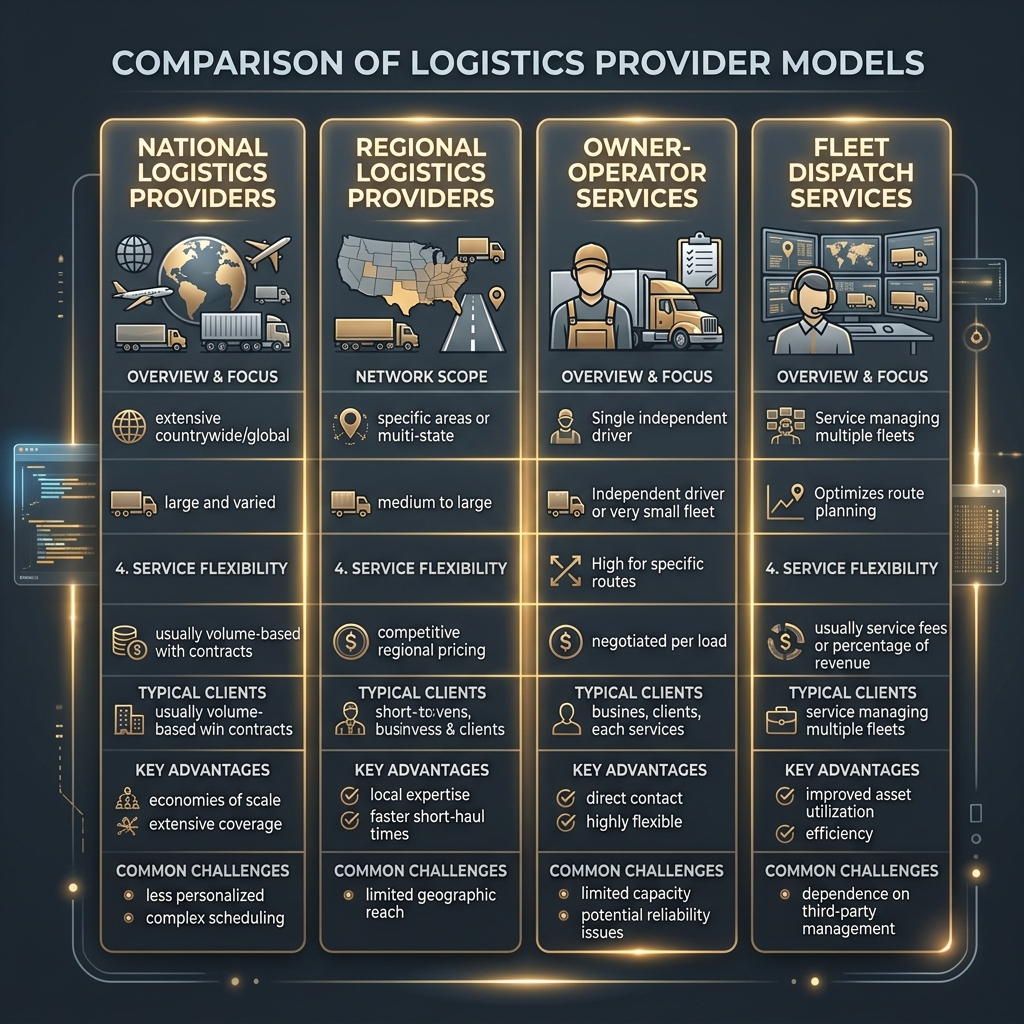
The dispatch market includes several different provider categories. Understanding these distinctions makes comparing options simpler.
National dispatch companies
National dispatch companies serve carriers across multiple states or throughout the country. Their potential advantages include broader geographic coverage and the ability to support carriers that regularly cross state lines. For a carrier regularly moving between Texas and other states, broader coverage can become more relevant.
Regional or Texas-focused dispatch companies
Regional providers concentrate on Texas or a smaller geographic area. Texas has an extensive freight network. TxDOT's Texas Connected Freight Corridors project focuses on I-35, I-45, and I-10 as the three legs of the Texas Triangle, with I-35 extending to Laredo. A regional provider may therefore position geographic familiarity as part of its value.
Owner-operator-focused dispatch companies
Owner-operator-focused services are designed around the needs of individual truck owners or small operations. The carrier may care particularly about keeping control over load decisions, finding freight compatible with one truck, avoiding unnecessary administrative work, understanding fees, and maintaining direct communication.
Fleet-focused dispatch companies
Fleet-oriented providers are designed around multiple trucks. Their services may emphasize centralized coordination, communication across several drivers, fleet-level planning, and managing a larger volume of dispatch activity.
Equipment-specialized dispatch companies
Some providers focus heavily on particular equipment categories. That can matter because freight requirements differ substantially between equipment types. Bonafide Trucking Solutions' locked dispatch-type context includes: dry van, reefer, flatbed, hotshot, box truck, power only, step deck, lowboy, and car hauler operations.
Full-Service vs. Limited-Scope Dispatch
Another important difference is how much work the dispatch company actually handles. "Full-service dispatch" is not a standardized industry package; different providers can use the term to describe different combinations of services.
Depending on the provider, dispatch support may include searching for freight, communicating with brokers, discussing load terms, coordinating load information, paperwork-related assistance, and other dispatch administration.
The potential advantage is convenience; more dispatch-related work can be delegated. The trade-off is that you may pay for services you do not need.
The potential advantage is that you retain more of the work while paying for a narrower service. The trade-off is that more responsibility remains with the carrier.
How Truck Dispatch Companies Charge
Pricing is another major difference between providers. Common structures include percentage-based fees, flat fees, and per-load charges.
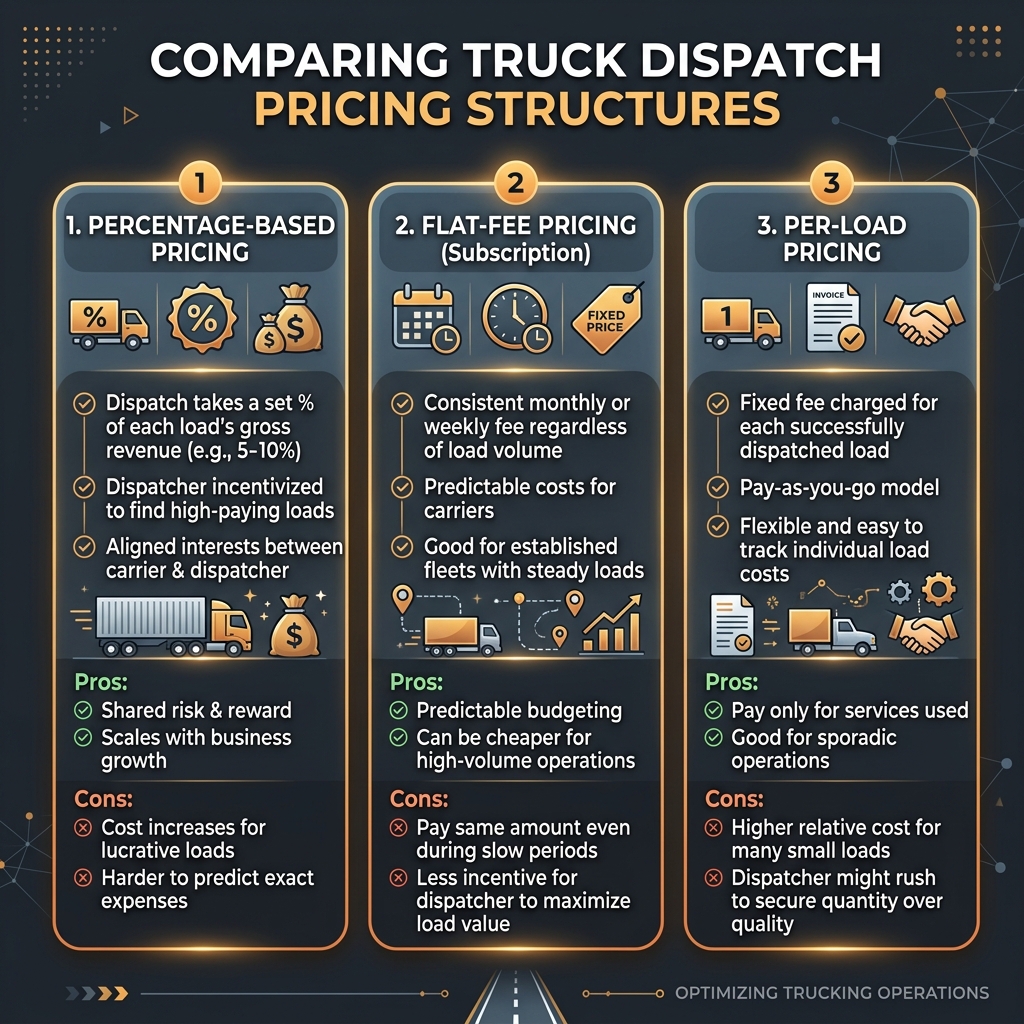
Percentage-based pricing: The dispatcher charges a percentage related to the carrier's revenue or load value, according to the agreement. A carrier should ask specifically: percentage of what? Is it calculated per load or over another period? Are accessorials included?
Flat-fee pricing: A fixed amount is charged according to the provider's arrangement. This can make the cost easier to understand before accepting freight, though the effective percentage changes depending on load values and volume.
Per-load pricing: The carrier pays a fixed dispatch charge for each load. This is simple to calculate, but the effective cost depends on the value of each load.
Bonafide-specific pricing is not stated here because no verified Bonafide pricing information is included in the locked facts for this page. For a deeper pricing guide, see Truck Dispatch Service Cost in Texas.
In-House vs. Outsourced Dispatch
Another distinction that is often overlooked is who actually performs the dispatch work. A company may directly employ and manage its dispatch personnel, or it may use remote, outsourced, or distributed personnel.
What Separates a Good Dispatch Company From a Bad One?
1. Transparent pricing: A carrier should understand the fee before agreeing to the service. The provider should explain how the fee is calculated and what it covers.
2. Clear carrier control: Ask who presents the load, who approves it, what happens if you reject it, and how preferences are managed. Do not assume all companies handle selection similarly.
3. Equipment knowledge: The service should understand the basic freight requirements associated with the equipment it handles (e.g. flatbed securement vs. dry van weight limits).
4. Reliable communication: Understand how you communicate, who handles your account, how loads are presented, and how problems are escalated.
5. Accurate documentation: FMCSA has specifically addressed transparency and the distinction between dispatch services and brokers in its regulatory guidance. A carrier should retain visibility into rate confirmations.
6. Regulatory clarity: A provider should understand the difference between dispatch-related activity and brokerage. FMCSA's final guidance explains that property brokers must obtain broker authority and maintain a $75,000 surety bond or trust fund agreement.
Why Texas Matters When Comparing Dispatch Companies
Texas is large enough that a carrier's geographic operating pattern can materially affect what type of dispatch service makes sense. TxDOT's planning identifies a broad network of highway, rail, border, port, and other freight infrastructure supporting Texas trade.
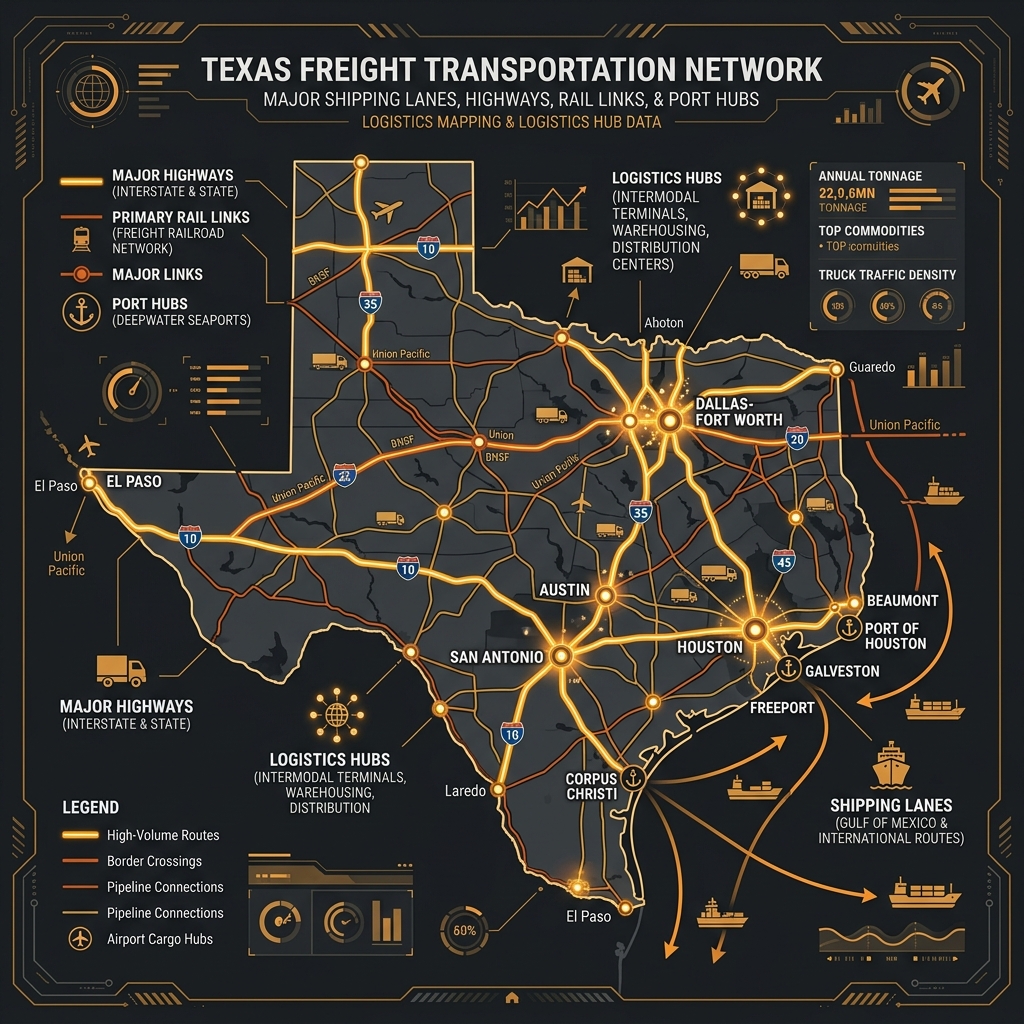
Its 2024 International Trade Corridors Plan identifies I-10, I-35, I-45, I-20, and other corridors as important trade routes. The state's network also has an important international component: TxDOT identifies 14 commercial motor vehicle border crossings, six international rail bridges, inland ports, marine ports, and airports supporting trade with Mexico.
For deeper information about Texas freight conditions, see the Texas Freight Market Report.
Where Bonafide Fits Into the Texas Dispatch Landscape
Bonafide Trucking Solutions is one dispatch option a Texas carrier can evaluate against the criteria above. Bonafide is a U.S. truck dispatch service serving owner-operators, independent truckers, small fleets, and carrier businesses across the 48 contiguous states.
Its dispatch-type context includes dry van, reefer, flatbed, hotshot, box truck, power only, step deck, lowboy, and car hauler operations.
If those basic criteria fit your operation and you want to evaluate Bonafide specifically, you can review the best dispatch service in Texas page.
Questions to Compare Before Choosing a Provider
For the detailed process of evaluating and hiring a provider, see How to Choose a Truck Dispatch Service in Texas.
Finding the Right Dispatch Fit for Your Texas Operation
The best truck dispatch company in Texas is not necessarily the company with the biggest advertising budget, the lowest advertised fee, or the most impressive marketing claim. Compare providers based on how their service models fit your equipment, operating area, budget, communication, and desired level of control.
Frequently Asked Questions
What makes a truck dispatch company good?
A strong dispatch provider should offer a service model that fits the carrier's operation, with clear pricing, defined responsibilities, appropriate equipment knowledge, transparent communication, and a clear understanding of its regulatory role.
Are percentage-based or flat-fee dispatch services better?
Neither is automatically better. Percentage pricing can vary with revenue, while flat or per-load pricing can provide a more predictable charge. Compare the effective cost with the actual services included.
Should I use a local Texas dispatcher or a national company?
It depends on where your trucks operate. A Texas-focused provider may be attractive to a carrier concentrated in Texas, while a carrier operating across many states may prefer broader geographic coverage.
Should a dispatcher specialize in my equipment?
Equipment knowledge can be important because freight requirements differ between dry vans, reefers, flatbeds, hotshots, box trucks, power-only operations, step decks, lowboys, and car haulers. Ask a provider which equipment it regularly handles.
Is a truck dispatcher the same as a freight broker?
No. FMCSA distinguishes brokers from bona fide agents and provides guidance concerning when dispatch-service activities may require broker authority. The provider's actual activities matter, not simply the label it uses.